What is Laser Technology?
Laser technology is one of the most transformative innovations of modern science, enabling breakthroughs across industries ranging from healthcare to advanced manufacturing. At its core, laser technology refers to the generation and controlled use of a highly focused beam of light, known as a laser beam, which possesses unique properties such as coherence, directionality, and high intensity.
Over time, innovations such as the fiber laser have revolutionized industrial production. These systems are more compact, efficient, and powerful than earlier technologies. Today, laser systems are widely used in manufacturing, telecommunications, medicine, and research, forming the backbone of many modern industries.
How Laser Technology Works
Laser systems operate on the principle of stimulated emission, where energy is amplified within a medium to produce a coherent beam of light.
Historical Development of Laser Technology
The origins of laser technology are rooted in fundamental physics discoveries of the 20th century. In 1917, Albert Einstein introduced the concept of stimulated emission, which became the theoretical foundation of all laser systems.
In the 1950s, Charles Townes, together with Soviet physicists Nikolay Basov and Alexander Prokhorov, developed the maser—an early device that amplified microwave radiation using the same principle. For this work in quantum electronics, they were awarded the 1964 Nobel Prize in Physics, recognizing their fundamental contribution to the development of laser technology.
The first true optical laser was demonstrated in 1960 by Theodore Maiman, who created a ruby-based system capable of generating a coherent laser beam. This milestone marked the beginning of practical laser systems and enabled the rapid expansion of modern laser applications.
Development of Fiber Laser Technology
A major breakthrough came with the development of the fiber laser. Elias Snitzer pioneered the concept of using optical fibers as a gain medium.
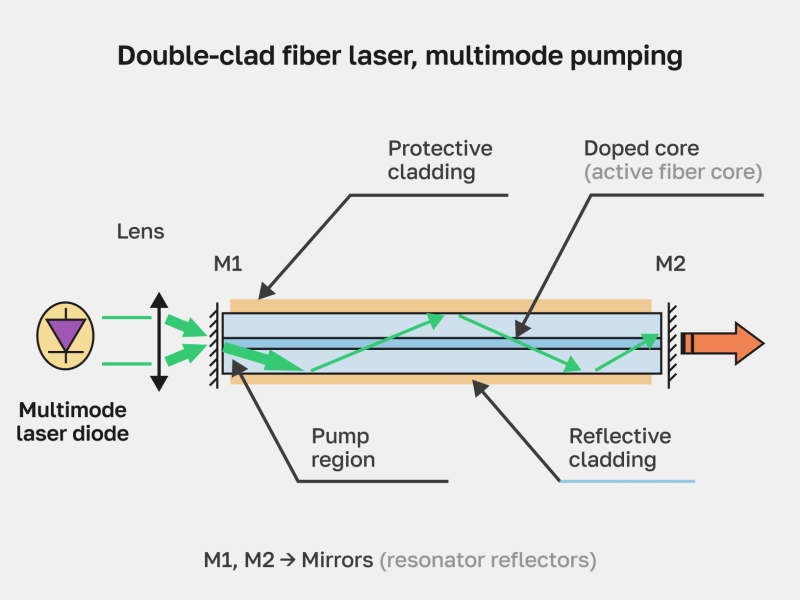
Double-clad fiber laser structure showing multimode pump light entering the cladding and amplifying the doped core
This design allows efficient energy transfer and enables high-power laser systems used in industrial applications.
Building on these foundations, Valentin P. Gapontsev transformed fiber lasers into powerful industrial tools. In the 1990s and early 2000s, he focused on increasing output power, efficiency, and reliability, making laser systems suitable for real-world industrial use.
Gapontsev’s key innovation was the practical implementation of high-power fiber lasers, where the active medium is a thin optical fiber capable of generating stable, high-intensity radiation. This made it possible to create compact, energy-efficient systems without the need for large-scale infrastructure.
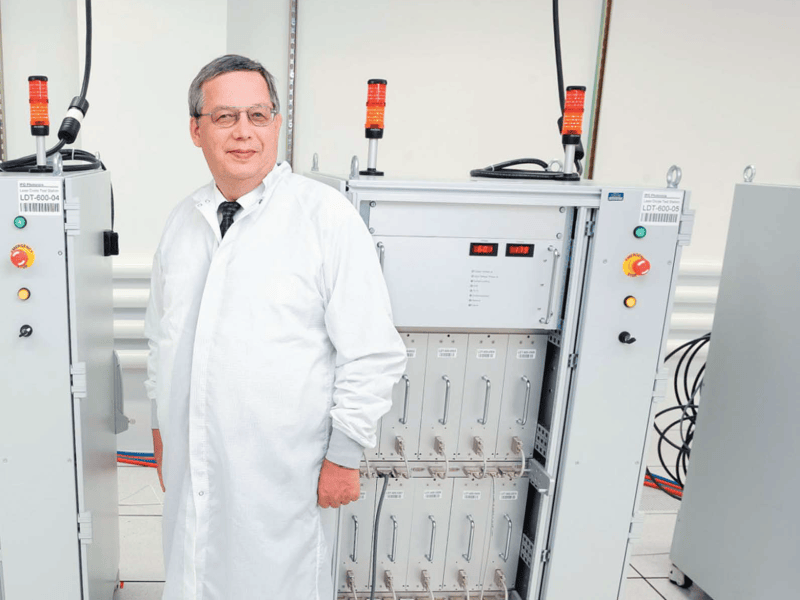
Valentin P. Gapontsev, pioneer of fiber laser technology and founder of industrial fiber laser development
As a result,
Fiber laser technology became dominant in laser material processing, enabling applications such as laser cutting, welding, and high precision cutting in advanced manufacturing.
Foundation of Fiber-Based Laser Applications
Modern laser systems depend on high-quality optical fiber. The production of optical fiber is a critical stage that determines performance, stability, and efficiency across all applications.
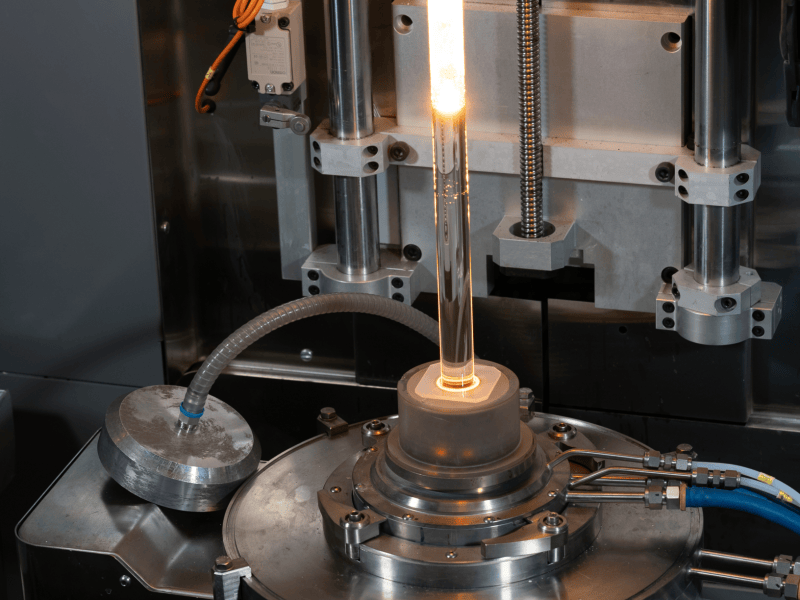
Optical fiber production process forming the foundation for industrial, medical, and telecommunications laser systems
During this process, glass is heated and drawn into extremely thin fibers with precise optical properties. These fibers are later used as the active medium in fiber lasers or as transmission channels in telecommunications.
Core Components of Laser Systems
A typical laser system consists of several key elements:
- Gain medium — provides optical amplification through stimulated emission
- Pump source — supplies energy to achieve population inversion
- Resonator (optical cavity) — provides optical feedback and supports mode formation
- Output coupler — partially transmits the amplified radiation to form the output beam
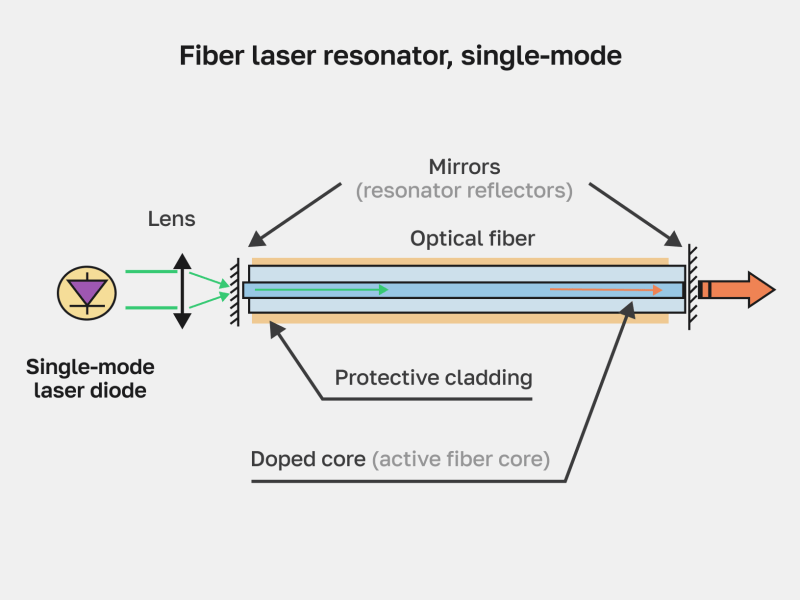
Single-mode fiber laser resonator showing diode pumping, doped fiber core, and mirror-based cavity for coherent laser beam generation. The resonator ensures feedback, allowing light to amplify and form a stable beam
Physical Principles Inside Fiber Lasers
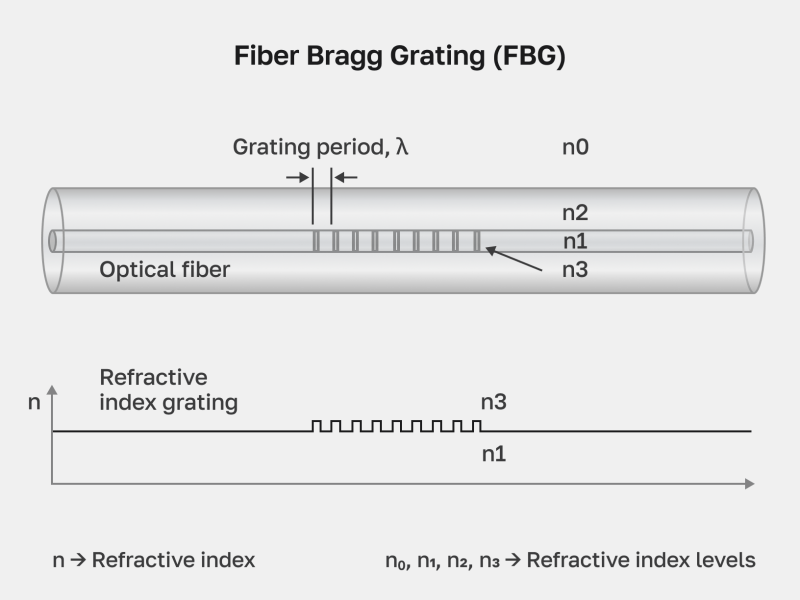
Fiber Bragg grating structure controlling wavelength and stability of the laser beam
Fiber Bragg gratings are used to control wavelength and improve beam quality, which is essential for precise laser applications.
Key Characteristics
- High precision cutting
- Strong energy concentration
- Minimal thermal distortion
- High repeatability
Laser Technology Applications
Manufacturing
Laser technology plays a central role in advanced manufacturing, especially in industrial environments where precision and efficiency are critical.
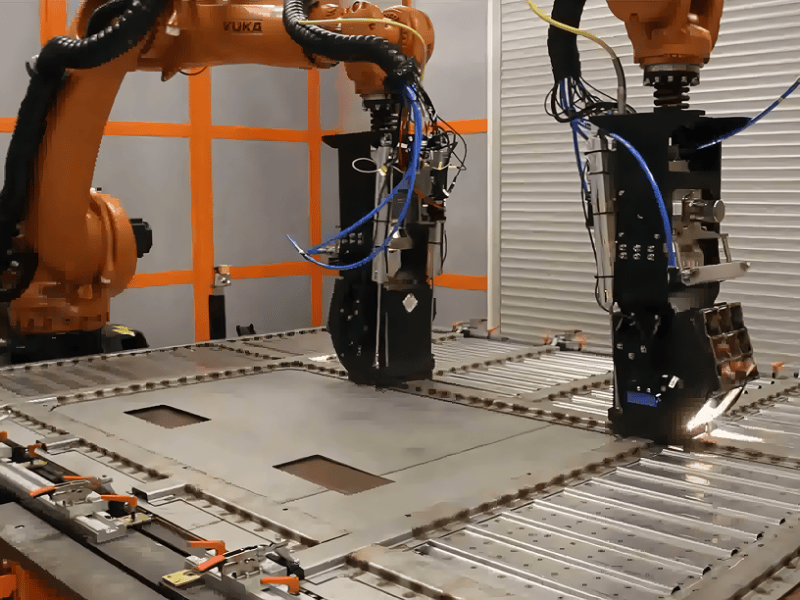
Laser welding process creating strong and precise joints in industrial manufacturing
Fiber lasers are widely used for:
- Laser cutting of metals
- Laser engraving and marking
- Welding and surface treatment
These industrial laser applications enable high-speed production with minimal waste and excellent accuracy.
| Application | Purpose | Key Advantage |
| Laser cutting | Material separation | Clean, precise edges |
| Laser engraving | Surface marking | Permanent, high detail |
| Laser welding | Joining materials | Strong, precise joints |
| Laser drilling | Micro-hole creation | High precision |
| Laser cleaning | Surface preparation | No chemicals required |
| Laser cladding | Surface coating | Extends component life |
| Laser hardening | Surface strengthening | Improves durability |
| Additive manufacturing | 3D metal printing | Complex geometries |
Explore all laser applications: Laser applications
Healthcare
Laser technology has significantly improved medical procedures by enabling:
- Minimally invasive surgeries
- High precision operations
- Faster recovery times
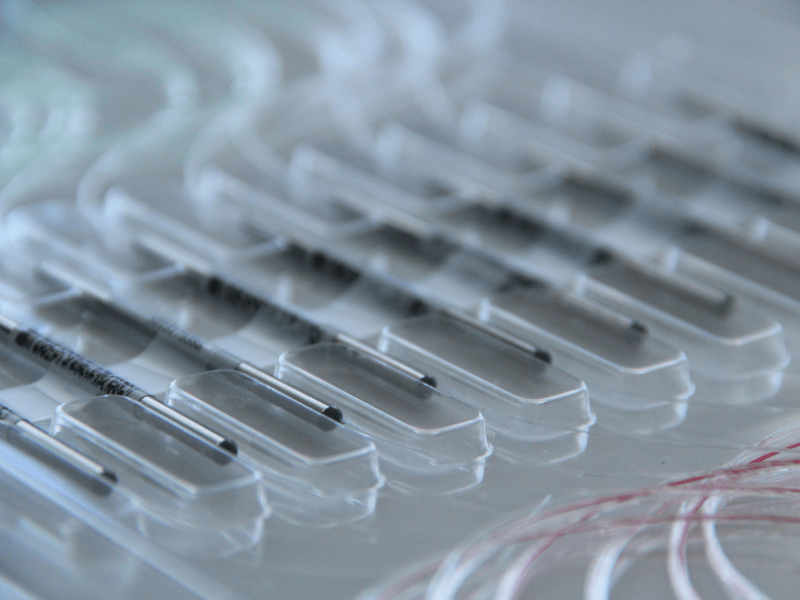
Fiber-optic delivery systems used in medical laser procedures for minimally invasive treatment
Laser-based medical devices have been developed using fiber technologies, expanding treatment possibilities in multiple clinical fields.
Explore all laser treatment applications: Clinical applications
Telecommunications
Laser systems are fundamental to modern communication technologies, particularly in fiber optics.
They enable:
- High-speed data transmission
- Signal amplification
- Reliable long-distance communication
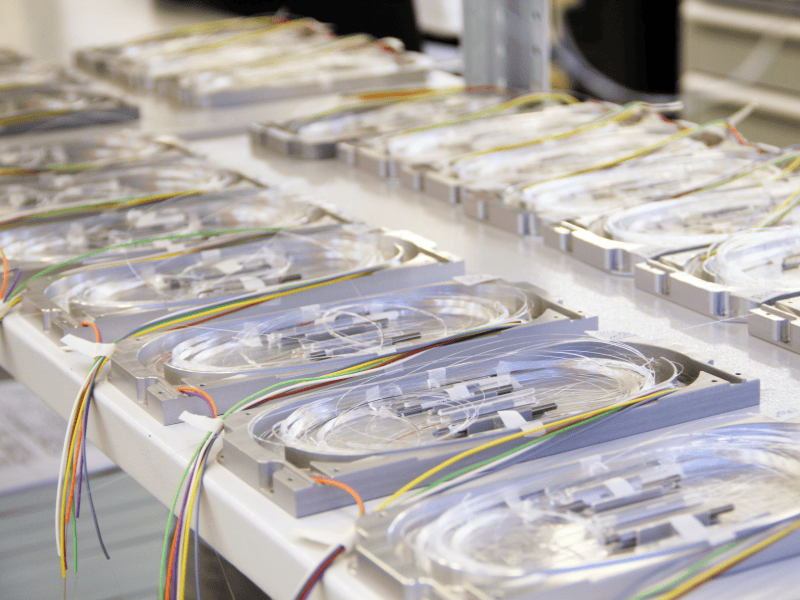
Optical fiber modules with coiled fibers and connectors used in laser and telecommunications systems
The rapid growth of optical communication systems created strong demand for laser-based solutions.
Explore telecommunications laser systems: Telecommunication systems
Defense and Research
Laser systems are widely used in scientific and defense applications, including:
- Precision measurement systems
- Aerospace technologies
- Advanced experimental research
High-power laser systems allow researchers to study materials and physical processes with extreme accuracy.
Explore laser systems for scientific research: Scientific Research & Education
Advantages of Laser Technology
Laser technology offers several important advantages:
- High precision and micron-level accuracy
- Contactless material processing
- Reduced material waste
- Compatibility with automation
- Faster production
- Multi-material flexibility
Additional Benefits
- Supports scalable industrial production
- Enables complex geometries
- Improves manufacturing efficiency
Challenges in Laser Technology
Despite its advantages, laser technology also presents challenges:
- High initial investment
- Requirement for strict laser safety measures
- Complexity of integrating laser systems into production
Proper laser safety systems are essential when working with high-power lasers to ensure safe operation.
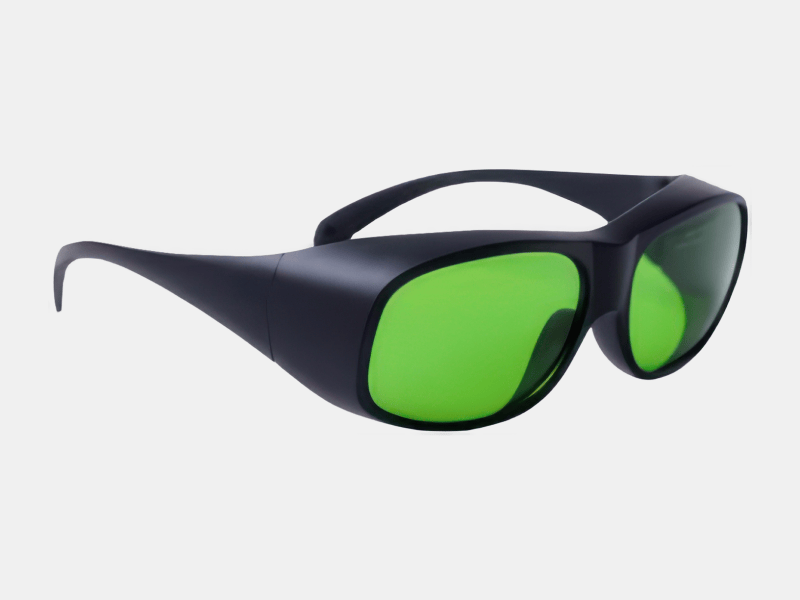
VPG LaserOne Laser Safety Glasses LP-YHP
Future of Laser Technology
The future of laser technology is closely linked to advances in photonics and fiber optics.
Key trends include:
- More compact and efficient fiber lasers
- Integration with robotics and AI
- Expansion into new industrial sectors
Gapontsev’s innovations demonstrated that fiber lasers could replace traditional systems and dominate industrial applications.
VPG LaserOne Solutions
VPG LaserOne continues the technological legacy established by Valentin P. Gapontsev, developing advanced fiber laser systems for high-precision industrial applications. These systems deliver reliability, efficiency, and scalability across a wide range of manufacturing environments.
These systems enable:
- High precision cutting and welding
- Laser engraving and marking
- Glass processing and precision structuring
- Surface treatment, including hardening, cladding, and cleaning
- Integration into automated manufacturing systems
- Optical signal transmission and amplification in fiber-optic telecommunications
- Medical applications, including minimally invasive procedures and high-precision surgery
By combining high output power with excellent beam quality, modern fiber laser systems provide consistent performance in demanding conditions. Their compact design and energy efficiency make them suitable for both large-scale production and specialized applications.
As a result,
Today, laser applications span manufacturing, healthcare, telecommunications, and research, making laser technology an essential component of technological progress.
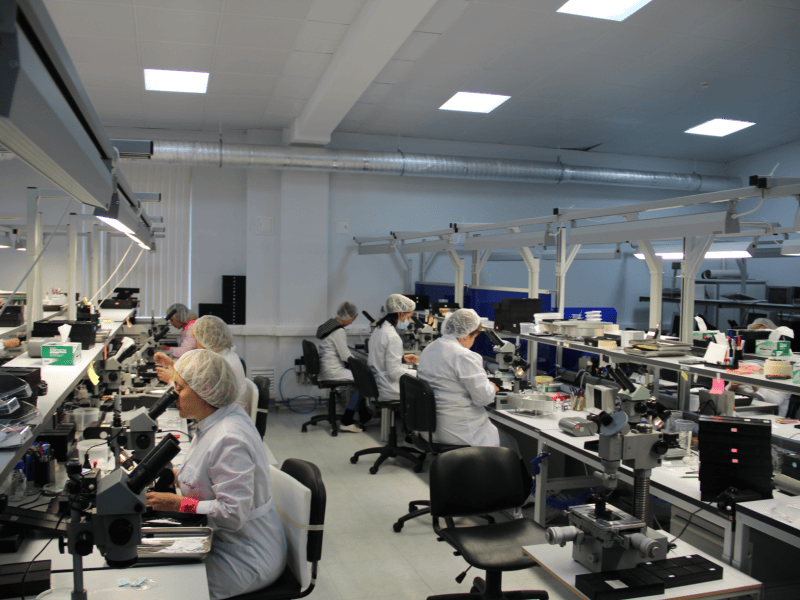
Precision optical assembly and quality control driving innovation in next-generation laser systems
Laser technology has evolved from a theoretical concept into a critical tool of modern industry. From Einstein’s early work on stimulated emission to the development of fiber lasers by pioneers like Snitzer and Gapontsev, the field has undergone continuous transformation.
Today, laser applications span manufacturing, healthcare, telecommunications, and research, making laser technology an essential component of technological progress.