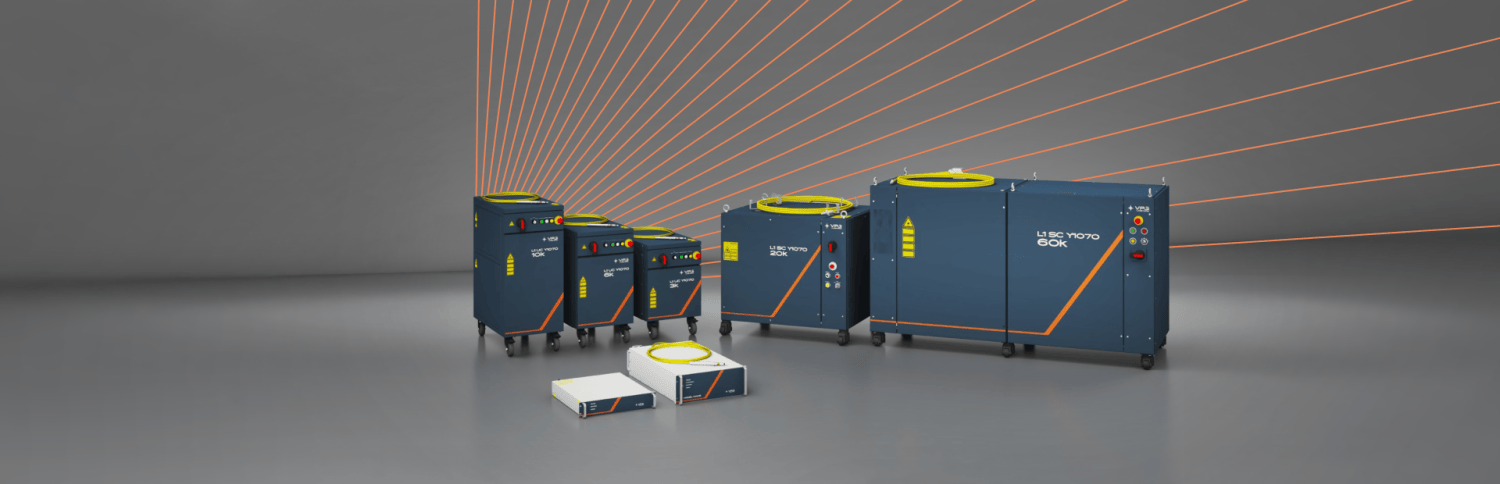
One portfolio. One naming logic. Clearer product identification for OEMs, integrators and industrial customers.
As laser technology evolves, product portfolios become broader — more power levels, wavelengths, operating modes and application-specific configurations. For engineers, OEMs and system integrators, this creates a practical challenge: a product name should help identify what a laser is, not require a separate lookup to decode it.
VPG LaserOne is introducing a new naming system across its laser source portfolio, bringing multiple product families under a unified L1 architecture.
This is more than a visual rebranding. The objective is to make the portfolio easier to navigate, specify and integrate.
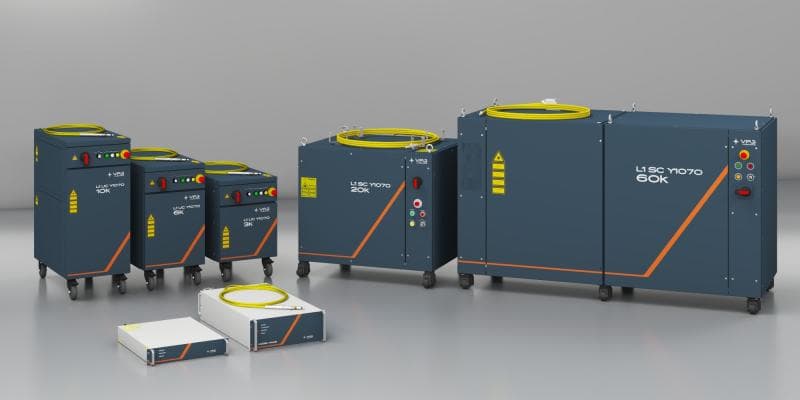
From legacy product names to a unified architecture
The new system replaces established family designations, including YLS, YLM, YLR, YLP and UPL, with structured L1 model names. Depending on the family, a designation indicates the source family or operating regime, wavelength, power class and relevant configuration or pulse parameters.
Rather than relying primarily on historical model names, the new nomenclature communicates key technical characteristics directly through the product designation:
- Laser type and operating mode — CW, QCW, or pulsed
- Wavelength — identifying the laser's spectral characteristics
- Output power — expressed in watts or kilowatts
- Specific configurations — including beam characteristics and pulse parameters where applicable
For example, YLS-20000 becomes L1-SC-Y1070-20k, identifying a 20 kW continuous-wave ytterbium fiber laser operating at approximately 1070 nm.
How to read a model name: L1-SC-Y1070-20k
| L1 | SC | Y1070 | 20k |
| L1 product naming system | CW source-family code | Ytterbium; approximately 1070 nm | 20 kW power class |
The same naming logic extends across the portfolio, from compact CW sources to high-power industrial lasers and ultrafast technologies.
One naming system across the laser source portfolio
The L1 nomenclature covers VPG LaserOne's major laser source families, providing a consistent approach to product identification while preserving their technological diversity.
The same naming approach is applied to different technologies, without treating them as interchangeable. The following examples illustrate the main directions rather than listing every model.
| Product direction | Naming logic | Example: previous → new |
| High-power CW fiber lasers | L1-SC identifies selected CW high-power configurations. | YLS-20000 → L1-SC-Y1070-20k |
| Compact and specialized CW | L1-UC, L1-RC and L1-RUC distinguish different CW configurations and form factors. | YLS-6000-U → L1-UC-Y1070-6k |
| Single-mode CW sources | SM suffixes preserve distinctions relevant to beam configuration. | YLR-2000-U-R-SM → L1-RUC-Y1070-2k-SM |
| QCW fiber lasers | L1-MQ / L1-SQ distinguish QCW families; output figures may express average and peak power. | YLM-600-6000-QCW → L1-MQ-Y1070-600/6k |
| Picosecond sources | L1-FP identifies ultrafast sources; names retain wavelength and pulse-related information. | UPL-100-15-100 → L1-FP-Y1030-100-15-100 |
| Nanosecond pulsed sources | L1-MP groups nanosecond sources and differentiates pulse configurations. | YLPN-0,4-100-20-GS → L1-MP-Y1070-20-0.4-100-GS |
| Visible / specialized wavelengths | Wavelength identifiers distinguish specialized spectral configurations. | GLR-535-200 → L1-RC-G536-200-SM |
Why this matters for OEMs and system integrators
A laser source is selected for a process and a machine architecture, not for its power rating alone. A consistent nomenclature can streamline early-stage source selection, engineering discussions, quotation requests, procurement specifications and service communication.
The new system also makes it easier to distinguish CW, QCW, nanosecond and picosecond families and to recognize wavelength or configuration differences within a family. This is particularly relevant when comparing sources for cutting, welding, marking and precision micromachining.
Continuity for existing customers
The new names provide a structured reference to established products. Customers can use the approved old-to-new cross-reference when updating technical documents, orders and project specifications. A naming change should not, by itself, be interpreted as a hardware upgrade or proof of interchangeability: approved datasheets and configuration requirements remain essential for any replacement or integration project.
One portfolio. One naming logic.
From high-power CW sources to compact CW modules, QCW lasers and ultrafast technologies, the L1 nomenclature creates a more consistent way to navigate VPG LaserOne’s laser source portfolio. The result is clearer product identification across technologies and a more practical starting point for technical selection.
One portfolio. One naming logic. A clearer way to specify laser technology.